


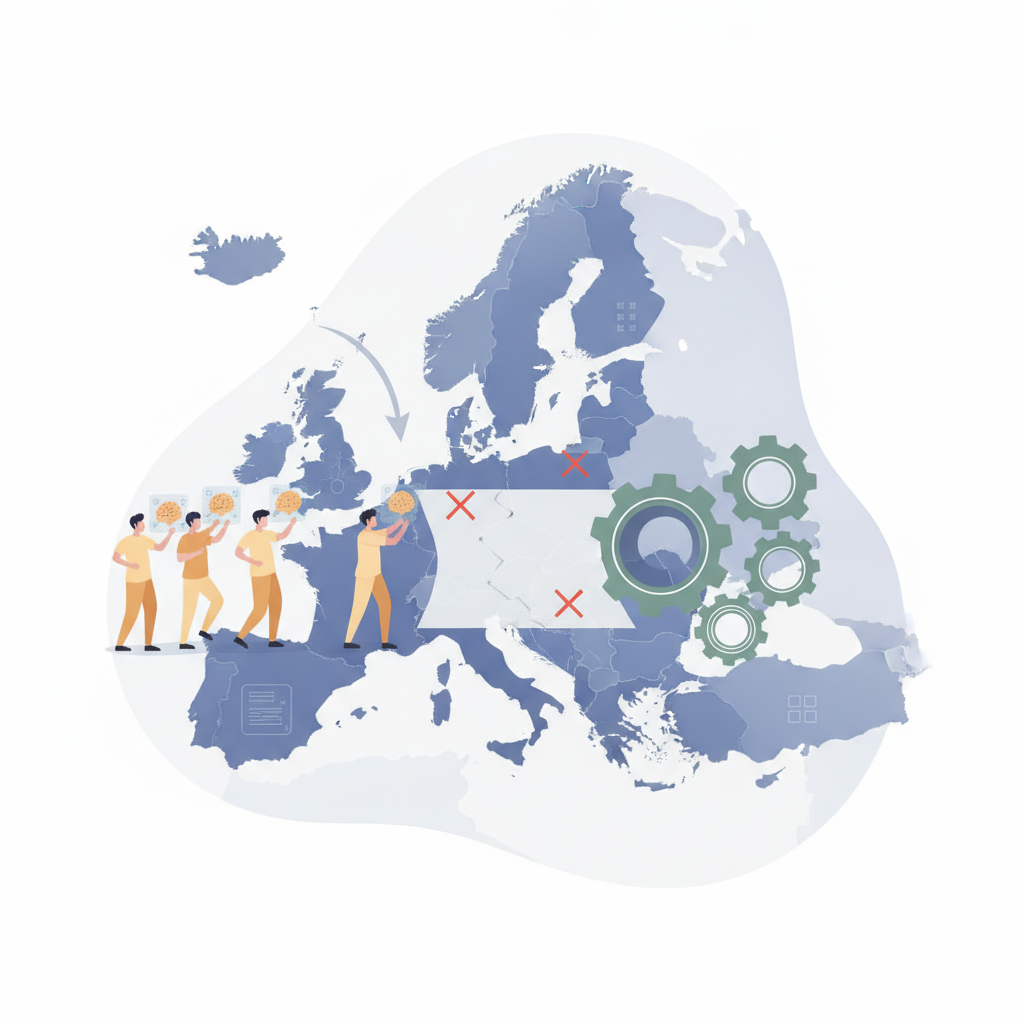
Europe is racing to secure its place in the global artificial intelligence landscape, but a new scenario analysis suggests that chips and computing infrastructure are only half the battle. A more immediate risk lies in a widening workforce skills gap that, if unaddressed, could quietly derail the continent's ambitions and carry a staggering economic cost. HR leaders are being urged to move reskilling from a long-term aspiration to an urgent operational priority.
The report, which models several future pathways for European competitiveness, puts a concrete number on the talent deficit—and the figure is sobering. It estimates that a failure to equip workers with AI-related competencies could drain hundreds of billions of euros from the economy over the next decade, wiping out productivity gains expected from automation and digital transformation. The message is clear: investing in technology alone is not a strategy; people must be at the center.
The Hidden Cost of the AI Compute Race
For the past two years, public and policy attention has fixated on semiconductors, supercomputers, and sovereign cloud infrastructure. These are critical, but the report’s scenarios shift the spotlight to the human layer. Without enough data scientists, machine learning engineers, AI ethicists, and tech-fluent domain experts, the advanced infrastructure will remain underutilized. Companies will be forced to delay projects, outsource critical capabilities, or abandon innovation initiatives altogether.
The talent crunch is not limited to deep tech roles. The analysis highlights a parallel scarcity of hybrid professionals—finance analysts who understand predictive modeling, HR specialists who can deploy AI-driven workforce planning tools, supply chain managers capable of interpreting algorithmic forecasts. These “AI-adjacent” skills are precisely where the productivity upside resides, yet they are rarely included in traditional upskilling budgets. By quantifying the opportunity cost, the report gives HR and business leaders a powerful argument to expand learning and development programs beyond IT departments.
Reskilling as a Strategic Imperative
For HR executives, the scenarios represent a call to rethink workforce planning from a risk-management perspective. Rather than treating reskilling as a nice-to-have benefit, leaders should frame it as a hedge against competitive decline. The report suggests that organizations which embed continuous learning into their operating models—through internal academies, cross-functional project rotations, and partnerships with educational institutions—are far more likely to meet their digital transformation goals.
This shift demands a new collaboration between HR, IT, and the C-suite. It means mapping existing employee capabilities against future needs, identifying adjacent skills that can be developed in months rather than years, and creating transparent career pathways that encourage retention. The report underscores that the most successful companies will not just hire their way out of the talent gap; they will build and borrow talent simultaneously, leveraging contingent workers and gig-based expertise to fill immediate voids while reskilling permanent staff for the long term.
From Insight to Action: What HR Leaders Can Do Now
The scenarios are not predictions—they are possible futures based on decisions made today. HR leaders who act early can help steer their organizations toward a more resilient path. Practical steps include auditing the existing workforce for latent digital skills, launching short-form credential programs co-designed with business units, and exploring agile staffing models that bring AI expertise in on a project basis without diluting institutional knowledge.
The report’s quantification of talent risk also serves as a communication tool. For the first time, HR can attach a financial number to the cost of inaction, making it easier to secure board-level buy-in for ambitious people strategies. In boardroom conversations where technology investments often dominate, this data reframes talent development as a direct contributor to competitiveness and shareholder value.
As the AI landscape evolves, the gap between organizations that invest in their people and those that merely buy technology will widen rapidly. The European economy’s digital future may well be decided not in datacenters, but in the everyday decisions HR leaders make about who gets trained, who gets hired, and how quickly skills can adapt.
Originally published by XMF, inspired by publicly reported industry news.
 Likes 0
 Save
Save
 Copy Link



 沪公网安备 31011702008840号
 Electronic Business License