

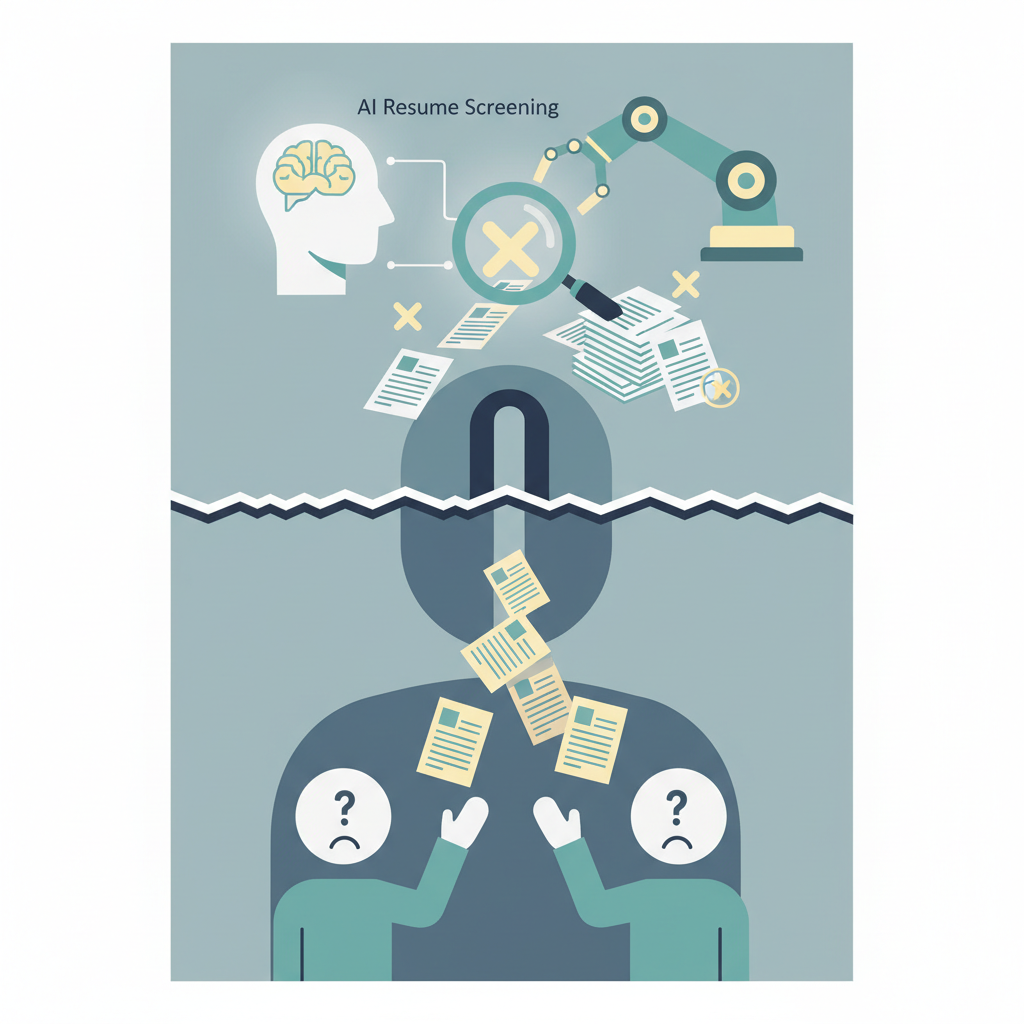
Artificial intelligence has become a standard part of high-volume hiring, promising to save recruiters time and surface the most relevant applicants. Yet a new concern is emerging from the people who use these tools every day: AI may be narrowing the candidate pool in ways that are hard to see.
A recent HR Executive report describes a “visibility gap” in AI resume screening. Recruiters say the technology helps them identify more qualified candidates, but many still worry that it cuts some applicants out of the process too early. In other words, the same system that speeds up screening may also be hiding good people from human eyes.
The Promise and the Blind Spot
AI screening works by scanning resumes for keywords, skills, experience levels, and other signals that match a job description. For recruiters handling hundreds or thousands of applications, this can be transformative. It reduces manual review time and helps ensure that obviously relevant candidates rise to the top.
But the blind spot is predictable. Automated filters rely on patterns. They look for the words and structures they have learned to associate with successful hires. A candidate who uses a different job title, comes from a less common industry, or has a non-linear career path may be just as capable—but the algorithm may rank them lower because their resume does not look like the expected profile.
This creates a subtle problem. Recruiters may believe they are seeing the best applicants, when in fact they are seeing the applicants whose resumes best match the tool’s learned preferences. The gap is not always about obvious discrimination. It is often about false negatives: qualified people who are excluded because their experience is described differently, or because they fall just outside a rigid threshold.
Why the Gap Is Hard to Notice
One reason the visibility gap persists is that organizations rarely audit what their screening tools reject. Recruiters focus on the candidates who make it through, because those are the people available for review. Without checking the filtered-out group, it is difficult to know how many strong applicants were removed too early.
Another reason is time pressure. When hiring teams are overwhelmed, they may set strict filters simply to make the workload manageable. This is especially common in remote and hybrid roles, where a single job posting can attract applicants from many regions and time zones. The tool becomes a way to cope with volume, and the human instinct to trust the shortlist grows stronger.
Over time, the algorithm’s output can shape what recruiters think the talent market looks like. If the tool consistently promotes candidates with certain credentials, teams may start to believe those credentials are more important than they really are. The screening system, in effect, narrows the definition of a “good candidate” without anyone making an explicit decision to do so.
Making Screening Smarter Without Losing People
HR leaders can reduce the visibility gap without abandoning AI. The first step is to treat automated screening as a recommendation engine, not a final verdict. Borderline candidates should be routed to a human review queue rather than automatically rejected. Adjusting thresholds, adding synonyms for critical skills, and expanding the range of acceptable experience can also help.
Regular audits are essential. By sampling rejected applications and checking them against the original job requirements, hiring teams can estimate how many false negatives the system is producing. If the number is high, the filters need adjustment. If certain groups or career backgrounds are consistently filtered out, that is a signal that the tool’s criteria do not match the organization’s actual hiring goals.
Transparency with candidates matters too. People should know when automation is part of the screening process and what criteria are being used. This is not only a question of fairness; it also builds trust with applicants who might otherwise feel they submitted a resume into a void.
For companies that hire remote and hybrid workers, the stakes are especially high. Distributed hiring should widen access to talent, not silently standardize it. If AI screening filters out unconventional or geographically diverse candidates before a human ever sees them, it works against the flexibility that remote work is supposed to provide. Hiring teams that rely heavily on automation may need to build deliberate human checkpoints into their process to protect that promise.
As more flexible-work platforms and recruiting tools adopt AI-assisted matching, the same caution applies. The goal should be to help recruiters see more of the right people, not to create a cleaner-looking shortlist that misses real potential. A well-designed system should make good candidates more visible, not less.
Originally published by XMF, inspired by publicly reported industry news.
 Likes 0
 Save
Save
 Copy Link



 沪公网安备 31011702008840号
 Electronic Business License